Welcome to My Blog!
I’m thrilled to have you here! Before we dive into the content, I’d love for you to join me on my social media platforms. It’s where I share extra insights, connect with our amazing community, and keep you updated on the latest news. Here’s how you can stay connected:
📘 Facebook: Lina Metal
▶️ YouTube: Lina Metal Channel – watch tutorials, demos, and in-depth guides
Now, let’s embark on this journey together! I hope you find the content here not only insightful but also inspiring and valuable. Let’s get started!
Table of Contents
Custom metal casting allows manufacturers to create metal components around specific drawings, materials, mechanical requirements, production volumes, and working environments rather than adapting a standard part to an unsuitable application.
For an OEM project, however, successful casting begins long before molten metal enters a mold.
Engineers must determine which casting process matches the component, how the geometry will solidify, which alloy provides the required properties, which dimensions can remain as-cast, where machining allowance is necessary, and how defects and dimensional variation will be controlled.
That makes custom metal casting an engineering and manufacturing decision rather than simply a purchasing decision.
Lina Metalworks provides custom casting services for small, large, simple, and complex metal components using processes including sand casting, metal mold casting, precision investment casting, centrifugal casting, and other casting methods. Secondary precision machining can then finish critical dimensions, holes, threads, sealing surfaces, and assembly interfaces.
Key Takeaways
- Custom metal casting should be selected according to geometry, material, quantity, tolerance, mechanical requirements, and expected secondary operations.
- Sand casting, investment casting, metal mold casting, and centrifugal casting solve different manufacturing problems.
- Casting-friendly DFM can reduce shrinkage, porosity, distortion, excessive machining, and unnecessary tooling complexity.
- Carbon steel, stainless steel, cast iron, aluminum, copper alloys, and other metals require different casting strategies.
- Critical tolerances should be separated from general as-cast dimensions.
- CNC machining should be planned before tooling when the finished component contains precision interfaces.
- Foundry quality depends on process control, material verification, dimensional inspection, and application-specific testing.
- A strong OEM casting supplier should be able to discuss the entire route from drawing and mold design through casting, machining, finishing, inspection, and production scaling.
What Is Custom Metal Casting?
Metal casting is a manufacturing process in which molten metal is introduced into a mold cavity, allowed to cool and solidify, and then removed as a finished or semi-finished casting. It is particularly useful for shapes that would be difficult or uneconomical to manufacture completely through material removal.
Custom metal casting applies this principle to components developed for a specific engineering requirement.
Instead of selecting an existing casting, the manufacturer develops the process around information such as:
- 2D drawings and 3D models
- required alloy
- component dimensions
- wall thickness
- mechanical properties
- annual demand
- dimensional tolerances
- machining requirements
- heat treatment
- surface treatment
- inspection criteria
- operating environment
The objective is to establish a repeatable manufacturing route capable of producing the required component efficiently and consistently.
For this reason, custom casting should be considered together with tooling, material behavior, post-processing, and quality control rather than treated as an isolated foundry operation.
Choosing the Right Custom Metal Casting Process
One of the most important decisions is determining how the component should be cast.
No single process is best for every project.
Lina Metalworks’ Casting manufacturing service currently includes sand casting, metal mold casting, precision lost-wax casting, centrifugal casting, and semi-solid casting, giving different options for part size, complexity, accuracy, and production requirements.
| Casting Process | Strongest Advantage | Typical Geometry | Production Consideration | Typical Materials |
|---|---|---|---|---|
| Sand casting | Flexible size and geometry | Medium to very large components | Suitable for varied quantities | Iron, steel, aluminum, copper alloys |
| Investment casting | Fine detail and precision | Small to medium complex components | Tooling justified by complexity/repeatability | Stainless steel, carbon steel, alloy steel |
| Metal mold casting | Repeatable production | Small to medium components | Better suited to repeated production | Commonly non-ferrous alloys |
| Centrifugal casting | Dense rotational components | Cylindrical and tubular geometry | Specialized geometry | Steel, iron, copper alloys |
| Semi-solid casting | Controlled structure and form | Selected complex components | Specialized process | Suitable alloy systems |
Sand Casting
Sand casting remains one of the most versatile methods for custom metal casting.
A pattern creates the required cavity within a sand-based mold. Molten metal enters the cavity, solidifies, and is removed after the mold is opened or broken away.
The process is particularly valuable when components are relatively large, structural, heavy, or unsuitable for more restrictive tooling systems.
Typical manufacturing considerations include:
- mold strength
- core design
- draft
- parting line
- metal flow
- riser location
- machining allowance
- surface finish requirements
Sand casting does not normally provide the same fine surface quality as investment casting, but it can be a more practical choice when component size and manufacturing flexibility are more important than extremely fine detail.
Investment Casting
Investment casting is especially useful for smaller or medium-sized components containing complicated surfaces, ribs, bosses, curved profiles, thin sections, or multiple integrated features.
A wax pattern is surrounded by a ceramic shell. After the wax is removed, molten metal fills the resulting cavity.
Because the process can reproduce fine geometry, it is frequently used where designers want to reduce extensive machining or combine several features into one component.
For stainless steel projects, our related guide on investment casting stainless steel explains alloy choice, casting tolerances, defect control, secondary machining, and inspection in greater detail.
Metal Mold Casting
Permanent metal molds can provide stronger dimensional consistency and faster repeat production than expendable molds for suitable applications.
Because the tooling is reused, the process becomes more attractive when expected production volume justifies the mold.
It should not automatically be selected simply because production volume is high. Alloy behavior, geometry, undercuts, wall thickness, thermal management, and tooling complexity must also be evaluated.
Centrifugal Casting
Centrifugal casting rotates the mold while molten material solidifies.
It is particularly applicable to circular and tubular components.
The process can be useful for sleeves, rings, bush-type structures, pipes, and other rotational forms where material distribution and structural integrity are important.
Start Custom Metal Casting With DFM
A major difference between an average casting project and a well-engineered one often appears during DFM.
Design for Manufacturing means reviewing the component according to the realities of the chosen production process before tooling is finalized.
A CAD model may describe the final geometry perfectly while still being difficult to manufacture reliably.
Control Wall Thickness
Large differences between adjoining wall sections can lead to uneven cooling.
Heavy sections generally remain hot longer than thin sections. This creates different solidification conditions across the component and may increase the risk of shrinkage, distortion, or internal defects.
Uniform or gradually changing sections are generally easier to control.
When structural requirements demand thicker areas, engineers should consider how those sections will be fed during solidification.
Avoid Abrupt Mass Changes
A thin wall transitioning immediately into a very heavy boss creates a thermal imbalance.
Where possible, use gradual transitions.
This can improve:
- mold filling
- solidification behavior
- stress distribution
- dimensional stability
Use Functional Fillets and Radii
Sharp internal corners can complicate casting and increase local stress concentration.
Appropriate radii can improve metal flow and structural continuity.
They can also help simplify pattern and mold production.
Consider Draft
Some casting methods require draft to allow the pattern or component to separate correctly from tooling or molding material.
Draft requirements depend on the casting process.
Applying one universal draft angle to every custom metal casting is therefore inappropriate.
Design Around the Parting Line
In processes using split molds, parting-line location can influence:
- tooling complexity
- flash
- dimensional accuracy
- finishing requirements
- core design
A small change in component orientation may sometimes simplify the mold substantially.
Selecting Materials for Custom Metal Casting
Casting material should follow application requirements rather than familiarity.
Lina Metalworks’ current casting capabilities include carbon steel, alloy steel, gray cast iron, ductile iron, stainless steel, aluminum alloys, copper alloys, magnesium alloys, and titanium alloys.
Carbon and Alloy Steel
Steel castings can provide useful combinations of strength, toughness, wear resistance, and heat-treatment response.
They are commonly considered for structural and mechanical components operating under significant loads.
Important factors include:
- required tensile properties
- impact performance
- heat treatment
- weldability
- wear resistance
- operating temperature
Stainless Steel
Stainless steel is commonly chosen when corrosion resistance must be combined with structural performance.
However, there is no universal stainless casting grade.
The alloy should reflect environmental conditions, mechanical loads, temperature, corrosion exposure, heat treatment, and required downstream processing.
Gray Cast Iron
Gray iron has long been used for industrial castings because of its castability, vibration damping, machinability, and suitability for many structural applications.
Potential applications include bases, housings, machinery structures, and other components where its material characteristics match the design.
Ductile Iron
Ductile iron provides different mechanical behavior from gray iron and can provide substantially greater ductility and strength.
It may be considered when a design needs the manufacturing flexibility of iron casting with higher structural performance.
Aluminum Alloys
Aluminum casting can reduce component weight while providing good corrosion performance and useful thermal properties.
Applications can include:
- housings
- machinery components
- structural supports
- electrical equipment components
- transportation structures
Alloy choice must consider both service performance and castability.
Copper Alloys
Copper and copper alloys can be selected when conductivity, corrosion behavior, wear properties, or specific mechanical characteristics are required.
Bronze and brass families are also used extensively across custom casting applications.
Custom Metal Casting Tolerances: As-Cast vs Machined
One of the most important cost-control decisions is determining which dimensions genuinely need tight tolerances.
A casting does not have to become a fully machined component.
Likewise, a dimension should not remain as-cast simply to avoid machining if it directly controls function.
ISO 8062 provides a framework for dimensional and geometrical tolerances and machining allowances for castings; ISO 8062-3 specifically addresses general dimensional and geometrical tolerances and machining allowance grades.
Good Candidates for As-Cast Dimensions
Depending on process capability, these may include:
- general external contours
- non-critical ribs
- structural walls
- clearance surfaces
- cosmetic areas
- non-locating bosses
Features Commonly Considered for Machining
Critical areas may include:
- bearing bores
- locating holes
- threads
- sealing faces
- shaft fits
- precision mating surfaces
- controlled flatness areas
- critical center distances
The drawing should clearly distinguish these two groups.
Over-tolerancing every feature can create unnecessary machining and inspection.
Under-specifying a critical surface can create assembly or functional problems.
The objective is therefore not “the tightest possible tolerance.”
It is the correct tolerance for each function.
Why Casting and CNC Machining Often Work Better Together
Custom casting is especially effective when it creates the majority of a complex shape close to final geometry.
CNC machining can then concentrate on the limited number of features that require higher precision.
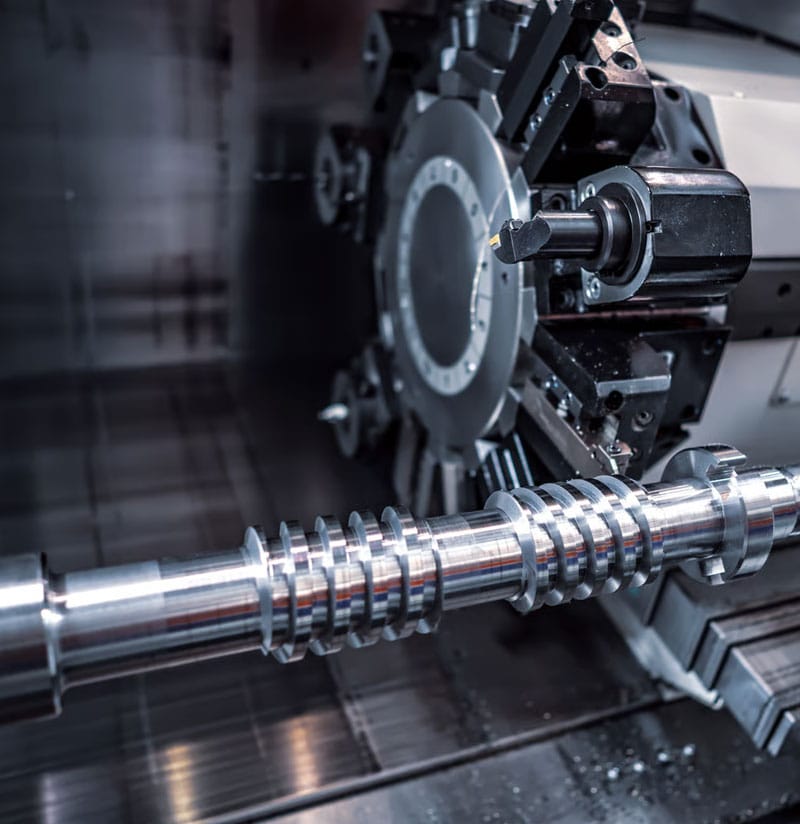
Lina Metalworks’ Machining service includes cutting, milling, turning, grinding, drilling, and boring, and specifically supports machining castings, forgings, and welded components into finished parts.
Consider a complex equipment housing.
Casting can create:
- external contour
- ribs
- mounting bosses
- internal cavity
- curved geometry
- reinforcing sections
Machining can then finish:
- bearing locations
- threaded holes
- mounting datums
- sealing surfaces
- precision bores
Producing the same part completely from a solid block could require removing a large amount of material and consuming significant machining time.
Conversely, attempting to cast every precision feature without machining may create unnecessary foundry difficulty.
The most efficient route is often hybrid manufacturing.
Tooling Strategy for Custom Casting Projects
Tooling decisions should reflect both current and future quantities.
A prototype program, a 500-piece annual requirement, and a stable 50,000-piece production program should not automatically use identical tooling strategies.
Low-Volume Projects
For lower quantities, engineering may prioritize:
- tooling flexibility
- easier modifications
- reduced initial complexity
- faster design iteration
Sand casting can be especially useful in some of these situations.
Repeat Production
As volume and design stability increase, more durable and repeatable tooling can become economically justified.
The key question is not merely annual quantity.
Engineers should also evaluate:
- projected product life
- design stability
- alloy
- casting cycle
- expected mold maintenance
- machining content
- rejection risk
- future capacity
Do Not Design Tooling Around an Unstable Part
If critical geometry is still changing, prematurely optimizing high-volume tooling can create costly modifications.
Where possible, validate function and DFM before locking the production mold.
Preventing Common Custom Casting Defects
Casting quality should be engineered into the process rather than inspected into the product afterward.
Potential casting defects are influenced by material, mold, geometry, pouring, feeding, cooling, and process control.
Shrinkage
Metal contracts during cooling and solidification.
If a heavy section cannot receive sufficient molten material as it solidifies, shrinkage defects may develop.
Possible control methods include:
- better section design
- optimized risers
- improved feeding paths
- adjusted gating
- controlled solidification
Gas Porosity
Gas trapped within molten metal can contribute to internal voids.
Melt quality, moisture, turbulence, degassing, mold conditions, and pouring practices may all influence the result. Foundry processing can include degassing where necessary to reduce dissolved or entrapped gases.
Inclusions
Non-metallic material can become trapped within the casting.
Control depends on factors including melt cleanliness, pouring practice, mold integrity, and process discipline.
Cold Shut and Misrun
If molten metal loses sufficient temperature or two streams fail to join properly, incomplete filling or cold-shut defects can occur.
Very thin or poorly fed sections may be more sensitive.
Distortion
Uneven cooling, residual stresses, geometry, and handling can affect dimensional stability.
DFM and controlled processing are therefore connected directly to final inspection results.
How Casting Simulation Supports DFM
Modern casting engineering can use simulation to study mold filling, cooling, solidification, thermal behavior, and potential problem areas before physical production begins.
Casting simulation is used to predict conditions such as filling behavior, thermal stresses, distortion, and component quality, helping engineers adjust the casting system before production.
Simulation does not replace foundry expertise.
Its value is greatest when software analysis and manufacturing experience are used together.
For difficult components, engineers may study:
- filling sequence
- hot spots
- feeding efficiency
- shrinkage risk
- temperature distribution
- solidification sequence
This can reduce unnecessary trial-and-error after tooling is completed.
Quality Control for OEM Custom Metal Casting
Quality requirements should reflect component function.
A decorative casting and a load-bearing machinery casting do not require identical inspection plans.
A practical quality plan can be divided into four areas.
Material Control
Depending on requirements, this can include:
- raw material verification
- chemical composition
- heat or batch identification
- material certificates
- heat-treatment records
Dimensional Inspection
Methods may include:
- calipers
- micrometers
- gauges
- custom fixtures
- CMM inspection
- profile measurement
The most important dimensions should be defined as critical characteristics on the drawing.
Surface and Visual Inspection
Visual inspection can identify obvious issues involving:
- incomplete filling
- cracks
- abnormal flash
- surface inclusions
- excessive grinding
- deformation
Acceptance standards should be agreed before production.
Non-Destructive Testing
When the component or industry requires it, additional testing may include:
- penetrant testing
- magnetic particle inspection
- radiographic testing
- ultrasonic examination
Not every casting needs every inspection method.
Adding tests without linking them to functional risk can increase manufacturing complexity without creating equivalent value.
Custom Metal Casting vs Forging vs Machining
OEM teams sometimes begin with a process name instead of a functional requirement.
A more useful approach is to compare the manufacturing characteristics.
| Requirement | Custom Casting | Forging | CNC Machining |
| Highly complex near-net geometry | Excellent | Moderate | Excellent but may require long machining time |
| Internal cavities | Strong | Limited | Possible with restrictions |
| Directional grain flow | Limited | Strong advantage | Depends on starting stock |
| Very low quantity | Depends on tooling | Often limited | Strong |
| Large structural shapes | Strong with suitable casting process | Possible depending on equipment | May be inefficient |
| Material utilization for complex shapes | Good | Good | Can require substantial material removal |
| Tight final tolerances | Usually requires selective machining | Often requires machining | Excellent |
| Part consolidation | Strong | Moderate | Moderate |
| Repeat production | Strong | Strong | Strong |
| Tooling requirement | Process-dependent | Usually required | Lower dedicated tooling requirement |
Casting is generally attractive when geometry itself creates significant manufacturing complexity.
Forging can become preferable when mechanical loading and material flow are dominant design considerations.
Machining remains highly effective when flexibility and tight dimensional control outweigh the cost of material removal.
A capable manufacturing supplier should evaluate the drawing instead of automatically recommending whichever process it happens to specialize in.
What Information Should Be Included in a Casting RFQ?
An incomplete RFQ makes accurate manufacturing evaluation difficult.
For a custom metal casting project, provide as many of the following as possible:
- 2D engineering drawing
- 3D CAD model
- alloy specification
- annual quantity
- batch quantity
- component weight
- critical tolerances
- machining requirements
- heat treatment
- surface treatment
- mechanical-property requirements
- corrosion environment
- working temperature
- pressure requirements if relevant
- inspection requirements
- applicable standards
- packaging requirements
When an exact alloy has not yet been finalized, provide functional requirements and operating conditions.
This gives the engineering team useful information for material and process selection.
How to Evaluate a Custom Metal Casting Manufacturer
Choosing a casting partner should go beyond comparing whether two suppliers can pour the same alloy.
Evaluate the complete manufacturing chain.
Process Selection Capability
A supplier offering several casting methods can evaluate the project against multiple manufacturing routes.
This matters because forcing every component into one foundry process can create unnecessary compromises.
Lina Metalworks currently provides several casting process options for components ranging from small precision parts to larger complex castings.
Secondary Processing
Ask whether the supplier can manage:
- CNC machining
- grinding
- heat treatment coordination
- welding
- brazing
- polishing
- coating
- final inspection
Lina Metalworks combines casting with machining, forging, stamping, bending, brazing, and other manufacturing capabilities rather than treating casting as an isolated operation.
DFM Support
A manufacturer should be able to explain why a wall is too heavy, why a radius should change, why a tolerance requires machining, or why another casting method may be more suitable.
A quotation alone does not demonstrate engineering capability.
Quality Planning
Before approving production, clarify:
- what will be inspected
- how often it will be inspected
- which dimensions are critical
- what material documentation is required
- which defects are acceptable or unacceptable
- whether additional NDT is necessary
Clear acceptance criteria reduce disputes after production.
Building a Casting-Focused Manufacturing Supply Chain
Complex OEM projects rarely end when the raw casting is removed from the mold.
A realistic production route might include casting, heat treatment, cleaning, CNC machining, grinding, surface finishing, inspection, and assembly.
Managing these operations as one connected manufacturing plan can improve datum consistency and simplify communication.
Lina Metalworks’ manufacturing platform combines casting with precision machining and other metalworking services. Its existing Custom Art Casting guide also discusses how different casting methods and machining can be combined for complex custom components.
This is particularly valuable when the casting itself is only the first stage of the finished component.
The manufacturing target should always be the final usable part—not simply a successful pour.
Conclusion
Custom metal casting is most effective when the entire component is designed around a controlled manufacturing route rather than when a finished CAD model is simply handed to a foundry.
The process begins with understanding geometry, alloy, operating conditions, production quantity, and functional requirements.
Engineers can then determine whether sand casting, investment casting, metal mold casting, centrifugal casting, or another process provides the most appropriate foundation.
From there, DFM should address wall thickness, section transitions, radii, parting strategy, gating, feeding, solidification, machining allowances, and critical tolerances.
For many industrial components, the best solution is not casting alone.
Combining custom metal casting with CNC machining, heat treatment, surface finishing, and application-specific inspection can transform a near-net-shape casting into a precision OEM component.
A strong custom metal casting project therefore answers four questions before tooling begins:
What should be cast?
What should be machined?
How should quality be verified?
How will the process scale when production increases?
When these decisions are made early, custom casting becomes more predictable, scalable, and suitable for long-term OEM manufacturing.
FAQ
What is custom metal casting?
Custom metal casting produces components according to specific drawings, materials, dimensions, mechanical requirements, and quantities. Unlike standard off-the-shelf castings, the mold, alloy, machining strategy, inspection requirements, and finishing processes are developed around the individual OEM application.
Which metal casting process should I choose?
The right process depends on component size, geometry, alloy, required surface quality, tolerances, production quantity, and tooling strategy. Sand casting is highly flexible for many large or structural parts, while investment casting is particularly useful for smaller complex components requiring finer detail and better near-net-shape accuracy.
Can custom castings achieve tight tolerances?
Casting can provide controlled dimensional accuracy, but the achievable tolerance depends strongly on process, component size, geometry, alloy, and tooling. Critical bearing fits, threads, sealing faces, locating surfaces, and precision bores are often designed with machining allowance and finished through CNC machining.
What causes defects in custom metal castings?
Casting defects can be influenced by part geometry, melt quality, gas, mold conditions, gating, feeding, pouring temperature, cooling, and solidification behavior. DFM, controlled foundry processing, appropriate gating design, inspection, and where appropriate casting simulation can reduce manufacturing risk.
What should I send to a custom metal casting manufacturer?
Provide a 2D drawing and 3D model where available, together with material specification, annual and batch quantities, critical tolerances, mechanical requirements, heat treatment, machining, surface finish, operating environment, inspection requirements, and applicable standards. Complete project information allows the manufacturer to recommend a more reliable casting route.