Table of Contents
Introduction
Brazing and soldering are both widely used methods for joining metal components without melting the primary base materials. Because the two processes share several fundamental principles, they are sometimes treated as interchangeable. In industrial manufacturing, however, the differences between brazing vs soldering can significantly affect joint strength, operating temperature, material compatibility, dimensional stability, sealing performance, and long-term reliability.
Both processes use a filler metal that melts and flows between closely fitted surfaces. The base components remain solid while the molten filler enters the joint and forms a metallurgical bond during cooling. The major distinction is the temperature range used to melt the filler metal, but this temperature difference leads to important changes in joint performance and application.
For engineers, OEM manufacturers, equipment designers, and industrial sourcing teams, selecting the correct joining process requires more than simply determining whether two metal components can be connected. The expected load, material combination, joint clearance, operating environment, heat exposure, production consistency, and subsequent manufacturing operations must all be evaluated.
Linametalworks provides custom brazing services for precision metal assemblies, thin-walled components, dissimilar metal joints, and industrial parts requiring reliable mechanical, thermal, electrical, or sealing performance.
What Is Brazing?
Brazing is a metal joining process in which a filler metal is heated above 450°C but below the melting temperature of the base metals being joined.
The base materials therefore remain solid throughout the operation.
Once the filler reaches its working temperature, it melts and flows into the narrow joint gap through capillary action. After cooling, the filler solidifies and forms a strong bond between the components.
Typical brazing applications include:
- Copper tubing assemblies
- Heat exchangers
- Hydraulic components
- Electrical connections
- Refrigeration systems
- Automotive components
- Aerospace assemblies
- Industrial tools
- Medical equipment components
- Dissimilar metal joints
One of the major advantages of brazing is its ability to connect materials that would be difficult to join using conventional fusion welding.
Linametalworks’ brazing process supports combinations involving steel, cast iron, copper alloys, aluminum alloys, nickel alloys, and other engineering metals, including applications where dissimilar materials must be joined.
What Is Soldering?
Soldering follows a similar basic principle but uses a filler material with a melting temperature below approximately 450°C.
Because the process operates at lower temperatures, soldering introduces less heat into the surrounding components.
This makes it particularly useful for delicate assemblies and temperature-sensitive applications.
Common soldering applications include:
- Printed circuit boards
- Electrical terminals
- Wire connections
- Small electronic assemblies
- Instrument components
- Light-duty plumbing
- Small precision assemblies
Soldering is especially common in electronics because excessive heat could damage components, insulation, or circuit-board materials.
The resulting joint is normally intended to provide electrical continuity, sealing, positioning, or relatively light mechanical support rather than carrying the substantial structural loads associated with many brazed assemblies.
Brazing vs Soldering: The Main Difference
The most widely recognized difference between brazing and soldering is filler-metal melting temperature.
| Factor | Brazing | Soldering |
|---|---|---|
| Filler melting temperature | Above approximately 450°C | Below approximately 450°C |
| Base metal melted | No | No |
| Typical joint strength | Higher | Lower |
| Heat input | Moderate to high | Lower |
| Common applications | Mechanical and industrial assemblies | Electronics and light-duty joining |
| Dissimilar metal capability | Excellent | Good for suitable combinations |
| Precision assemblies | Highly suitable | Highly suitable |
| Typical production uses | Automotive, machinery, aerospace, heat transfer | Electronics, electrical components |
This temperature distinction affects several other manufacturing characteristics.
Higher brazing temperatures allow filler alloys with greater mechanical and thermal capabilities to be used. Lower soldering temperatures reduce thermal distortion and protect delicate components.
Neither process is universally better. Their suitability depends on the operating requirements of the final assembly.
How Brazing Creates a Strong Metal Joint
A successful brazed joint depends heavily on capillary action.
When two metal surfaces are positioned with an appropriate gap, molten filler metal can flow between them without requiring the base metals themselves to melt.
Several factors determine whether this occurs effectively:
- Joint clearance
- Surface cleanliness
- Filler-metal compatibility
- Heating uniformity
- Flux performance
- Base material
- Component geometry
Joint clearance is particularly important.
If the gap is excessively wide, capillary action may weaken and the filler may not distribute evenly. If the gap is too narrow, molten filler may have difficulty entering the joint.
Accurate component manufacturing therefore contributes directly to brazing quality.
This is one reason brazing is often combined with CNC machining, stamping, or precision sheet-metal forming. The joining process can only perform consistently if the mating components are themselves manufactured within appropriate dimensional limits.
The Role of Surface Preparation
Even a correctly designed joint can fail if the surfaces are contaminated.
Metal components may carry:
- Oil
- Grease
- Oxides
- Cutting fluids
- Dust
- Scale
- Handling contamination
These substances can prevent the filler metal from properly wetting the base material.
Preparation may therefore involve:
- Degreasing
- Solvent cleaning
- Mechanical cleaning
- Chemical cleaning
- Oxide removal
The exact procedure depends on material type and manufacturing conditions.
Cleanliness becomes especially critical for copper, stainless steel, aluminum, nickel alloys, and precision components where oxide layers can interfere with filler flow.
A controlled manufacturing process should therefore treat cleaning as part of the brazing operation rather than as an optional cosmetic step.
What Is Wetting in Brazing and Soldering?
Wetting describes the ability of molten filler metal to spread across and bond with the surface of the base material.
Good wetting is essential in both brazing and soldering.
If the molten filler forms isolated droplets rather than spreading across the surface, a reliable metallurgical connection may not form.
Wetting behavior is influenced by:
- Surface cleanliness
- Filler composition
- Base metal composition
- Joint temperature
- Flux selection
- Atmosphere
This explains why two materials that physically fit together may still require a carefully selected filler alloy and controlled heating method.
Material compatibility should therefore be evaluated before production begins.
Why Flux Is Used
During heating, metal surfaces can rapidly oxidize.
Oxide films interfere with filler-metal wetting and prevent stable joint formation.
Flux helps remove existing oxides and reduces further oxidation during joining.
Different flux formulations are designed for different material and temperature combinations.
For industrial brazing, flux selection depends on:
- Base metal
- Filler alloy
- Brazing temperature
- Heating method
- Joint configuration
After brazing, flux residues may need to be removed because some residues can affect appearance, corrosion behavior, or later processing.
In controlled-atmosphere or vacuum brazing, the process environment itself may reduce or eliminate the need for conventional flux.
Brazing Filler Metals
Filler-metal selection is one of the most important engineering decisions in brazing.
Common filler systems include:
- Silver-based alloys
- Copper-based alloys
- Nickel-based alloys
- Aluminum-based alloys
- Brass-based alloys
Selection depends on:
- Base materials
- Required joint strength
- Operating temperature
- Corrosion environment
- Electrical conductivity
- Thermal conductivity
- Joint clearance
- Brazing method
For example, copper-based filler materials may be suitable for certain steel or copper applications, while aluminum assemblies require filler systems specifically designed for aluminum alloys.
Nickel-based brazing alloys are often selected for components exposed to elevated temperatures or demanding operating environments.
The filler should therefore be treated as an engineered part of the assembly rather than simply a material used to fill a gap.
Soldering Filler Metals
Soldering uses lower-melting filler alloys.
Modern solder materials may use combinations involving:
- Tin
- Silver
- Copper
- Bismuth
- Other alloying elements
Electronics manufacturing increasingly relies on lead-free formulations designed to meet environmental and manufacturing requirements.
Solder selection may need to balance:
- Melting behavior
- Electrical conductivity
- Joint reliability
- Thermal cycling
- Component sensitivity
- Process compatibility
A solder joint carrying an electrical signal has different performance priorities from a brazed joint supporting an industrial structural component.
That difference should guide process selection.
Brazing vs Soldering Joint Strength
Joint strength is one of the primary reasons engineers choose brazing instead of soldering for industrial assemblies.
Properly designed brazed joints can provide significant mechanical strength because the filler alloy forms a strong metallurgical connection across a relatively large joint area.
Lap joints are especially effective because load is distributed over the overlapping surfaces.
Soldered joints generally provide lower mechanical strength.
They are highly effective for applications where the primary function is:
- Electrical connection
- Positioning
- Sealing
- Light mechanical support
However, soldering is normally not selected as the primary joining method for highly loaded industrial structures.
When strength is critical, engineers should evaluate the entire assembly rather than only filler-metal properties.
Joint geometry, overlap length, loading direction, material thickness, and operating temperature can all influence final performance.
Brazing vs Soldering for Dissimilar Metals
Joining dissimilar metals can be challenging with fusion welding because each metal may have very different melting temperatures, thermal expansion behavior, and metallurgical characteristics.
Brazing provides an important alternative because the base materials do not need to melt.
This makes brazing useful for combinations such as:
- Copper to steel
- Copper to stainless steel
- Copper to brass
- Nickel alloy to steel
- Certain aluminum combinations
Linametalworks specifically supports brazing for dissimilar metal assemblies, including copper-aluminum, copper-steel, and nickel-alloy-to-steel connections where the joint design and material combination are appropriate.
Dissimilar-metal joints still require careful engineering.
Different thermal-expansion coefficients can create stress as the assembly heats and cools. Electrochemical compatibility may also need consideration when the finished product is exposed to moisture or corrosive environments.
Brazing vs Welding
Brazing is also commonly compared with welding.
The main difference is that fusion welding normally melts at least part of the base materials, while brazing does not.
This distinction creates several practical consequences.
| Factor | Brazing | Fusion Welding |
|---|---|---|
| Base metal melting | No | Usually yes |
| Dissimilar metals | Often easier | Can be difficult |
| Heat-affected region | Generally smaller | Often larger |
| Thin components | Highly suitable | Requires careful control |
| Complex multi-joint assemblies | Strong capability | Depends on accessibility |
| Joint appearance | Often clean | Depends on process |
| Heavy structural joints | Application dependent | Highly suitable |
Brazing may be advantageous when components are thin, dimensionally sensitive, or made from different metals.
Welding may be more suitable when deep fusion and very high structural loading are required.
The decision should therefore reflect the part rather than a general preference for one joining method.
Brazing vs Soldering for Electronics
Electronics represent one of the clearest examples of when soldering is usually preferred.
Electronic assemblies often contain temperature-sensitive components and extremely small connections.
A lower-temperature joining process helps limit thermal exposure.
Typical soldered components include:
- PCB terminals
- Wire connections
- Connectors
- Switches
- Sensors
- Electronic modules
Brazing appears in electrical and electronics manufacturing as well, particularly for components requiring stronger joints, higher operating temperatures, hermetic sealing, or improved thermal conductivity.
Examples can include:
- Heat sinks
- Power components
- Electrical contacts
- Sensor housings
- Specialized connectors
The required function determines the correct joining method.
Brazing for Heat Transfer Components
Brazing is particularly important in heat-transfer equipment.
Typical applications include:
- Radiators
- Heat exchangers
- Condensers
- Evaporators
- Cooling systems
- Refrigeration assemblies
These products often contain numerous thin-wall tubes, fins, plates, or channels that must be connected without excessive distortion.
A properly brazed joint can combine mechanical connection with fluid sealing and thermal conductivity.
Maintaining controlled gaps across multiple joints is especially important in these assemblies.
Precision manufacturing before brazing directly affects the consistency of filler flow during the heating cycle.
Brazing for Automotive Applications
Automotive manufacturing uses brazing in several types of components where sealing, strength, repeatability, and heat-transfer performance are important.
Applications may include:
- Radiator assemblies
- Air-conditioning components
- Fuel-system components
- Tubing
- Heat exchangers
- Electrical assemblies
Production-scale brazing can be automated using induction heating, furnace systems, controlled atmospheres, and specialized fixtures.
Automation helps maintain repeatability, but fixture design and part geometry remain critical.
If components do not consistently locate in the fixture, automated heating cannot compensate for poor joint positioning.
Brazing in Medical and Precision Equipment
Medical and precision equipment can require small, clean joints with controlled dimensional change.
Applications may involve:
- Instrument components
- Sensor assemblies
- Metal housings
- Tubing
- Precision connectors
Stainless steel and special alloys are frequently used because of corrosion resistance and mechanical performance.
The joining process must be compatible with the material as well as later cleaning, finishing, or sterilization requirements where applicable.
Linametalworks lists medical devices among the industrial sectors supported by its broader metal manufacturing applications, together with automotive, electronics, machinery, agriculture, and other industrial fields.
Heating Methods Used in Brazing
Brazing can be performed using several heat sources.
The correct method depends on part geometry, production quantity, material, and filler alloy.
Torch Brazing
Torch brazing uses a flame to locally heat the joint.
It provides flexibility for individual components, repair work, and many manual production environments.
Induction Brazing
Induction heating uses electromagnetic energy to rapidly heat conductive components.
Advantages can include:
- Localized heating
- Fast cycles
- Repeatability
- Automation compatibility
It is particularly useful for repeat manufacturing when joint location and component geometry remain consistent.
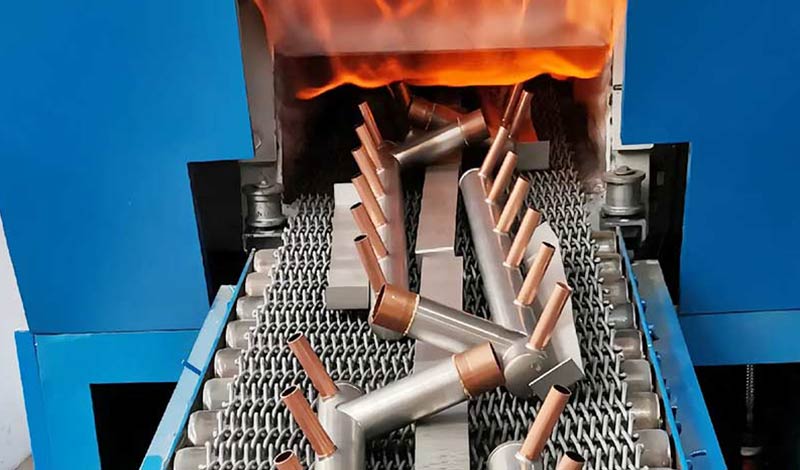
Furnace Brazing
Furnace brazing allows multiple components or joints to be processed within a controlled heating cycle.
It can be useful for:
- Complex assemblies
- Multiple joints
- Batch production
- Controlled-atmosphere processing
Fixtures may be used to maintain component positions during heating.
Vacuum Brazing
Vacuum brazing is used for specialized components requiring highly controlled joining conditions.
The low-pressure environment helps reduce oxidation and can produce clean joints without conventional flux in appropriate applications.
Vacuum brazing is particularly relevant to aerospace, electronics, high-temperature alloys, and precision assemblies.
Controlling Distortion During Brazing
One major advantage of brazing over some fusion welding processes is that the base metals do not melt.
However, the components still expand when heated and contract during cooling.
Poor heating control can therefore cause:
- Warping
- Joint movement
- Dimensional change
- Residual stress
Several strategies help control distortion:
- Balanced joint design
- Uniform heating
- Proper fixturing
- Controlled heating rates
- Controlled cooling
- Appropriate filler placement
Thin sheet-metal assemblies require particular attention because relatively small thermal forces can move the component.
This is another reason the entire manufacturing chain must be considered before joining.
The Importance of Fixtures in Brazing
Fixtures keep components aligned during heating.
They may control:
- Joint clearance
- Part orientation
- Component position
- Assembly geometry
However, fixtures must also allow for thermal expansion.
A fixture that constrains the assembly too rigidly can create stress as temperatures increase.
Fixture materials must also tolerate repeated thermal cycles without contaminating the joint or reacting with the components.
Production fixture design therefore becomes an important part of repeatable brazing.
How CNC Machining Supports Brazed Assemblies
Brazing is often combined with precision machining.
Machining may be used before brazing to create:
- Joint shoulders
- Alignment features
- Controlled gaps
- Locating surfaces
- Flow channels
After brazing, machining may create:
- Final mounting surfaces
- Threads
- Bores
- Sealing interfaces
- Precision dimensions
Combining machining and joining allows manufacturers to use brazing for assembly while reserving very tight dimensional requirements for CNC finishing.
Linametalworks’ broader metal manufacturing services include machining, stamping, bending, casting, forging, spring processing, and brazing, allowing multiple processes to be incorporated into a single component strategy.
How Stamping and Forming Support Brazed Parts
Many brazed assemblies begin as stamped or formed components rather than machined blocks.
Examples include:
- Sheet-metal brackets
- Heat exchanger fins
- Electrical terminals
- Thin-wall housings
- Tube assemblies
Stamping can efficiently establish part geometry, while brazing joins multiple formed pieces into a functional assembly.
Repeatability of the upstream forming process directly affects downstream brazing.
If stamped components vary in dimensions, their joint gaps may also vary, causing inconsistent filler flow.
This connection between tooling, forming precision, positioning, and automated production is also relevant in broader metal-processing operations. JB金博利达’s discussion of CNC control in metal processing lines illustrates how servo positioning, automated feeding, tooling, and coordinated process control are used to improve repeatability in modern metalworking environments.
The same manufacturing principle applies to brazed assemblies: a stable joining process begins with stable components.
Common Brazing Defects
Understanding typical defects helps manufacturers establish effective preventive controls.
Incomplete Filler Flow
Possible causes include:
- Incorrect joint clearance
- Insufficient heating
- Contamination
- Poor filler positioning
Porosity
Porosity may result from contamination, trapped gases, flux issues, or unsuitable process conditions.
Excessive Filler
Too much filler can create unnecessary buildup around the joint and affect appearance or later assembly.
Oxidation
Improper atmosphere, flux, or heating control can cause excessive oxidation.
Component Distortion
Uneven heating or poor fixturing may alter component geometry.
Weak Joint Formation
Weak joints may result from incompatible filler, inadequate wetting, insufficient overlap, contamination, or poor joint design.
Inspection should therefore evaluate both appearance and functional requirements.
Quality Control for Brazed Assemblies
Brazed components may require several types of inspection depending on their intended function.
Common methods include:
- Visual inspection
- Dimensional inspection
- Leak testing
- Pressure testing
- Pull testing
- Metallographic examination
- Non-destructive examination
A heat exchanger, for example, may require leak testing in addition to dimensional checks.
A structural assembly may require mechanical testing.
Electrical components may need resistance or conductivity verification.
Quality control should therefore be based on product function rather than applying the same inspection plan to every brazed part.
How to Choose Between Brazing and Soldering
A structured comparison can simplify process selection.
Choose brazing when the project generally requires:
- Higher joint strength
- Industrial mechanical performance
- Higher service temperatures
- Stronger dissimilar-metal joints
- Pressure or fluid sealing
- Structural or semi-structural connections
Consider soldering when the project generally requires:
- Low processing temperature
- Electronic component protection
- Electrical conductivity
- Small precision connections
- Light mechanical loading
Neither decision should be based only on process temperature.
The complete application should include considerations such as material compatibility, service environment, geometry, production method, inspection, and expected product life.
Questions Engineers Should Ask Before Selecting a Joining Process
Before choosing brazing or soldering, engineers should answer several questions:
- What materials need to be joined?
- Will the assembly carry mechanical loads?
- What temperatures will it experience in service?
- Is electrical conductivity important?
- Is thermal conductivity important?
- Does the assembly require airtight or liquid-tight sealing?
- How sensitive are nearby components to heat?
- What joint geometry is possible?
- Will the component require later machining?
- What inspection is required?
These questions often make the appropriate manufacturing route much clearer.
Why Process Integration Matters
Industrial components rarely require only one manufacturing process.
A finished product may pass through:
- Stamping
- Bending
- CNC machining
- Cleaning
- Brazing
- Inspection
- Surface finishing
- Assembly
Managing these processes separately can introduce dimensional and communication problems if manufacturing requirements are not coordinated.
An integrated approach allows joint clearance, machining allowance, surface treatment, and fixture location to be considered during the original component design.
For OEM customers, this can improve consistency because each manufacturing stage is planned around the final assembly rather than treated as an independent operation.
Conclusion
The brazing vs soldering comparison begins with filler-metal temperature, but the real manufacturing differences extend far beyond that single specification.
Brazing operates at higher temperatures and is typically selected for stronger industrial joints, dissimilar metals, heat-transfer systems, tubing, precision assemblies, and components requiring reliable mechanical or sealing performance.
Soldering operates at lower temperatures and is especially valuable for electronics, electrical connections, delicate components, and applications where limited thermal exposure is important.
Successful process selection requires consideration of base materials, joint design, filler alloy, service temperature, mechanical loading, electrical or thermal requirements, component geometry, cleanliness, heating method, and inspection strategy.
Linametalworks supports custom brazing for complex metal assemblies along with machining, stamping, bending, casting, forging, and other metal-processing capabilities. For projects involving dissimilar materials, thin-wall components, precision joints, or integrated metal assemblies, customers can contact Linametalworks to discuss drawings and manufacturing requirements.
Frequently Asked Questions
What is the main difference between brazing and soldering?
The main distinction is filler-metal melting temperature. Brazing uses filler metals that melt above approximately 450°C while remaining below the base-metal melting point, whereas soldering generally operates below that threshold. This difference influences joint strength, thermal exposure, filler selection, and typical applications.
Is brazing stronger than soldering?
Brazed joints generally provide greater mechanical strength than soldered joints and are therefore commonly used in industrial, mechanical, automotive, heat-transfer, and structural applications. Actual joint strength still depends on material compatibility, joint geometry, filler selection, clearance, cleanliness, and process control.
Can brazing join different metals?
Yes. Brazing is particularly useful for joining compatible dissimilar metals because the base materials do not need to melt. Copper-to-steel and nickel-alloy-to-steel are examples of combinations that may be brazed when appropriate filler metals, clearances, heating methods, and joint designs are used.
Does brazing melt the base metal?
No. A defining characteristic of brazing is that the base components remain solid. Only the filler metal melts and flows into the joint. This can reduce distortion and makes brazing suitable for thin components, precision assemblies, and some dissimilar-metal combinations.
When should manufacturers choose brazing instead of welding?
Brazing can be advantageous when joining thin components, dissimilar metals, multi-joint assemblies, heat-transfer parts, or components where melting the base metal could cause excessive distortion. Welding may be more appropriate for applications requiring deep fusion or certain highly loaded structural joints.