Welcome to My Blog!
I’m thrilled to have you here! Before we dive into the content, I’d love for you to join me on my social media platforms. It’s where I share extra insights, connect with our amazing community, and keep you updated on the latest news. Here’s how you can stay connected:
📘 Facebook: Lina Metal
▶️ YouTube: Lina Metal Channel – watch tutorials, demos, and in-depth guides
Now, let’s embark on this journey together! I hope you find the content here not only insightful but also inspiring and valuable. Let’s get started!
Table of Contents
Ordering custom springs involves more than sending a drawing and comparing prices. Material grade, spring load, working environment, tolerances, heat treatment, inspection methods, and packaging can all influence the final performance.
Before choosing a supplier, use this Spring Processing checklist to confirm the following points:
- Define the spring type and intended function.
- Provide complete dimensions and load requirements.
- Select materials based on stress and working conditions.
- Separate critical tolerances from reference dimensions.
- Confirm heat treatment and surface finishing.
- Request samples before approving mass production.
- Establish inspection methods and acceptance criteria.
- Review tooling, MOQ, lead time, and delivery terms.
- Verify packaging and batch traceability requirements.
- Keep all approved specifications under revision control.
What Does Spring Processing Include?

Spring Processing is the controlled manufacture of elastic components from metal wire, strip, or sheet. Depending on the design, production may include wire preparation, coiling, forming, straightening, end grinding, heat treatment, shot peening, surface finishing, inspection, and packaging.
The objective is not simply to reproduce the shape shown on a drawing. A qualified process must also deliver the required force, deflection, fatigue life, dimensional consistency, and environmental resistance.
Common Types of Processed Springs
Different spring structures respond to different forms of mechanical force. Identifying the correct type is therefore the first step in preparing a useful request for quotation.
Compression Springs
Compression springs resist axial loads as they are compressed. Buyers normally need to specify the free length, outside or inside diameter, wire diameter, spring rate, working height, and required load.
Extension Springs
Extension springs absorb and store energy when pulled apart. In addition to the spring body, hook shape, initial tension, hook orientation, and maximum extended length require careful definition.
Torsion Springs
Torsion springs produce torque around a central axis. Leg length, leg angle, coil direction, working rotation, shaft clearance, and torque are important purchasing parameters.
Custom Wire Forms
Wire forms include clips, retaining parts, pins, latches, and other nonstandard shapes. Their performance may depend more on angles, bend locations, and assembly fit than on a conventional spring rate.
You can review Lina Metal Works’ available Spring Processing services and common spring applications before preparing your project specifications.
Step 1: Define the Spring’s Actual Function
A clear application description helps the supplier identify risks that may not be obvious from a two-dimensional drawing. Explain whether the component must store energy, return a mechanism, absorb vibration, maintain contact, control motion, or transmit torque.
Load and Deflection
State the required load at one or more working positions. If only the free length and wire dimensions are supplied, the manufacturer may not have enough information to confirm whether the spring will perform correctly in the assembly.
Static or Cyclic Operation
A static spring remains at a relatively stable load for long periods, while a cyclic spring repeatedly compresses, extends, or rotates. Cyclic applications normally require closer attention to operating stress, fatigue life, surface condition, and stress concentrations.
Working Environment
Temperature, moisture, chemicals, salt exposure, dust, and electrical requirements can change the appropriate material and coating. Buyers should describe actual service conditions instead of requesting stainless steel or plating without explaining the reason.
Step 2: Prepare Complete Spring Processing Specifications
A complete specification reduces quotation assumptions and makes supplier comparisons more reliable. The drawing should use consistent units, readable dimensions, revision numbers, and clearly identified critical features.
Spring Drawing Checklist
| Specification | What the Buyer Should Provide | Why It Matters |
|---|---|---|
| Spring type | Compression, extension, torsion, or wire form | Determines the forming and testing method |
| Material | Grade, standard, wire size, and condition | Affects strength, corrosion resistance, and cost |
| Dimensions | Diameter, free length, coils, angles, and end details | Controls assembly fit |
| Load requirement | Load at a specified height or deflection | Confirms functional performance |
| Spring rate | Required rate and tolerance, if critical | Controls force change during movement |
| Working range | Minimum and maximum operating positions | Helps evaluate stress and coil interference |
| Service life | Expected number of cycles | Guides fatigue and process decisions |
| Heat treatment | Required process or performance target | Stabilizes properties and relieves forming stress |
| Surface finish | Plating, coating, polishing, or passivation | Supports corrosion or appearance requirements |
| Inspection | Test method, sampling plan, and reports | Establishes objective acceptance criteria |
| Quantity | Prototype, annual demand, and batch size | Affects tooling and unit cost |
| Packaging | Bulk, layered, separated, or custom packaging | Prevents tangling, deformation, and surface damage |
Use Functional Requirements Where Possible
A drawing may specify every physical feature, but the spring still needs to work inside a real mechanism. Supplying load, deflection, installation space, mating shaft or hole sizes, and service-life expectations allows the Spring Processing supplier to evaluate manufacturability more effectively.
Mark Critical and Reference Dimensions
Not every dimension should carry the same priority. Identify which measurements directly affect safety, load, assembly, or motion, and mark secondary measurements as reference dimensions where appropriate.
Step 3: Choose the Right Spring Material
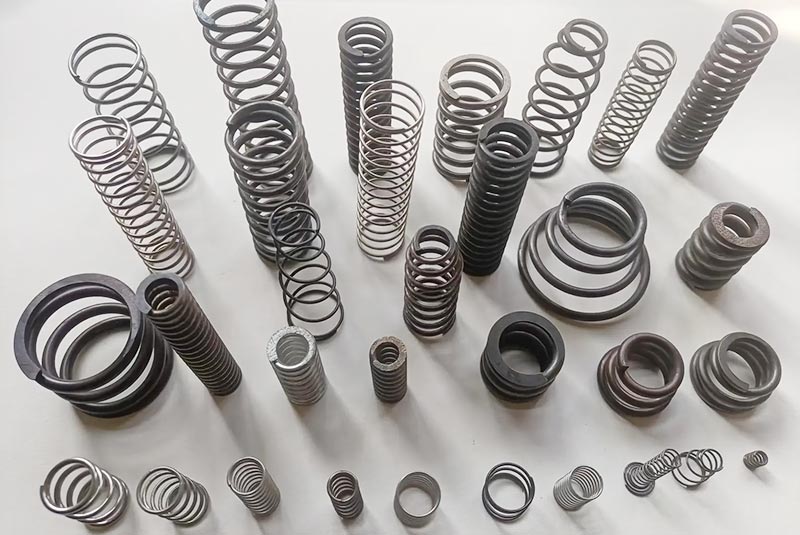
Material selection should balance mechanical performance, corrosion resistance, temperature, availability, and budget. Choosing the most expensive alloy does not automatically produce the best component.
Carbon Steel Spring Wire
Carbon steel wire is widely used for general industrial springs because it combines good strength with economical production. It normally requires suitable protection when used in humid or corrosive environments.
Stainless Steel
Stainless steel is useful where corrosion resistance, cleanliness, or appearance matters. Grades such as 304, 316, and 17-7PH offer different combinations of formability, strength, and environmental resistance.
Alloy Spring Steel
Alloy steel may be selected for higher loads, demanding fatigue conditions, or elevated operating temperatures. Its processing route and heat treatment must be matched to the specified mechanical properties.
Copper and Copper Alloys
Phosphor bronze, brass, and other copper alloys are suitable for conductive components and certain corrosion-resistant applications. They are frequently used in electrical contacts, switches, and small precision mechanisms.
For an overview of internationally recognized wire specifications, buyers can consult the relevant ASTM steel standards. The exact applicable standard should be agreed upon with the supplier before production.
Step 4: Set Realistic Tolerances
A spring is an elastic formed component, not a rigid CNC-machined part. Wire properties, coiling behavior, heat treatment, and residual stress all create normal manufacturing variation.
Dimensional Tolerance
Dimensional controls may include wire diameter, outside diameter, inside diameter, free length, solid height, coil count, hook orientation, and leg angle. The drawing should state how each dimension will be measured.
Load and Rate Tolerance
In many applications, load at a specified working height is more important than free length. If a tight load tolerance is required, the manufacturer may need flexibility in a noncritical dimension to adjust performance during Spring Processing.
Tight Tolerance vs Functional Tolerance
| Comparison Point | Tight Tolerance | Functional Tolerance |
|---|---|---|
| Main goal | Minimize dimensional variation | Ensure fit and performance |
| Production impact | More adjustment and inspection | Focuses control on critical features |
| Cost | Usually higher | Often more economical |
| Scrap risk | Higher | Lower when properly defined |
| Best suited for | Safety-critical or precision assemblies | General industrial applications |
Unnecessarily tight tolerances can increase sampling, machine adjustment, inspection time, and rejection rates without improving the assembly. Buyers should apply strict limits only where variation would affect fit, function, reliability, or safety.
Step 5: Confirm the Spring Processing Route
The supplier should understand the complete production sequence before quoting. Changes in forming, heat treatment, end processing, or finishing can affect both performance and delivery time.
Coiling and Forming
CNC coiling and forming equipment controls coil diameter, pitch, length, angles, and other geometric features. Complex designs may require special tools, forming stations, or secondary operations.
Heat Treatment
Heat treatment can relieve stress created during forming and establish required mechanical properties. The correct method depends on the alloy, wire condition, component size, and required performance.
End Processing
Compression spring ends may be closed, squared, or ground to improve seating. Extension spring hooks and torsion spring legs may also require secondary forming to achieve their final geometry.
Surface Treatment
Common options include zinc plating, phosphating, passivation, painting, powder coating, polishing, and oiling. The finish should be selected according to exposure conditions and must not interfere with dimensional fit or spring movement.
Step 6: Approve Samples Before Mass Production
A physical sample helps confirm details that are difficult to evaluate from a drawing alone. It can reveal interference, unstable seating, excessive noise, hook misalignment, or unexpected force behavior.
What Should Be Tested?
Sample approval should include dimensional measurements, load or torque tests, assembly trials, and surface inspection. Fatigue, corrosion, or temperature testing may also be necessary for demanding applications.
Golden Sample
A golden sample is a mutually approved reference part retained for production comparison. It should be linked to a controlled drawing revision and documented inspection results.
Prototype vs Production Sample
A prototype may be produced with temporary tooling or a different process to verify the design quickly. A production sample should use the intended material, equipment, tooling, heat treatment, and finish whenever possible.
Step 7: Review the Supplier’s Quality Controls
A reliable supplier should be able to explain how incoming material, forming operations, heat treatment, finishing, and final inspection are controlled. General claims about “high quality” are less useful than clearly defined records and procedures.
Material Traceability
Ask whether the supplier can connect finished batches to material certificates, production dates, and inspection records. Traceability becomes especially important when multiple materials or heat-treatment lots are used.
Measuring Equipment
The appropriate equipment depends on the specification. Calipers, micrometers, optical measuring systems, load testers, torque testers, hardness testers, and coating-thickness gauges may all be used during Spring Processing.
Inspection Reports
Confirm which documents will be supplied with the order. Possible records include dimensional reports, material certificates, load-test results, coating reports, first article inspection reports, and certificates of conformity.
Step 8: Compare Spring Processing Quotations Correctly
The lowest unit price does not always represent the lowest purchasing cost. A quotation based on missing specifications may later require changes, additional tooling, or expensive inspection.
| Quotation Item | Supplier A | Supplier B | Question to Ask |
|---|---|---|---|
| Material | Generic stainless steel | Specified grade and standard | Are the materials truly equivalent? |
| Tooling | Included | Listed separately | Who owns and maintains the tooling? |
| Testing | Dimensional inspection | Dimensions plus load testing | Does testing match the drawing? |
| Samples | Prototype sample | Production-process sample | Which sample reflects mass production? |
| Surface finish | Basic plating | Defined coating specification | Are corrosion requirements comparable? |
| Packaging | Bulk packed | Separated trays | Could transport damage affect usable yield? |
| Lead time | Production only | Includes material and finishing | What does the stated lead time cover? |
Unit Price vs Total Cost
Total cost includes tooling, sample approval, inspection, packaging, freight, customs documentation, rejected parts, and production delays. A stable supplier may create more value even when the quoted unit price is slightly higher.
Standard Tooling vs Custom Tooling
Standard tooling may reduce initial cost and shorten sample development. Custom tooling is more appropriate when the spring has unusual ends, multiple bends, complex geometry, or demanding repeatability requirements.
Local Supplier vs Overseas Supplier
A local supplier may offer shorter communication and transport cycles, while an overseas supplier may provide broader capacity or more competitive batch pricing. The right choice depends on order volume, technical complexity, inventory strategy, and supply-chain risk.
Step 9: Confirm Commercial and Delivery Details
Technical approval does not complete the purchasing process. MOQ, tooling ownership, order quantity, production capacity, lead time, payment terms, export documents, and delivery responsibilities must also be recorded.
Minimum Order Quantity
Ask whether the MOQ is based on machine setup, raw material purchase, heat-treatment batches, or surface-finishing requirements. Understanding the reason may help both parties find a practical order quantity.
Packaging Requirements
Small springs can tangle, while large or slender components may deform during transport. Plated and polished springs may need separators, trays, or protective wrapping to prevent scratches and contact damage.
Change Control
No drawing or process change should enter production without approval. Purchase orders should reference the latest drawing number, revision, material specification, finish, and approved sample.
Common Spring Purchasing Mistakes
Ordering From a Picture Alone
A photograph can show the general structure but cannot reliably define load, wire grade, tolerances, heat treatment, or fatigue requirements. For accurate Spring Processing, provide a drawing, sample, or complete technical specification.
Specifying Only Free Length
Two springs with the same free length may deliver very different forces. Wire diameter, mean coil diameter, active coil count, material, and heat treatment all influence performance.
Requesting the Tightest Possible Tolerance
A supplier can quote tighter tolerances, but that does not mean they are useful. Functional tolerances usually produce better value by controlling the characteristics that matter to the assembly.
Skipping Production Sample Approval
A prototype that fits once does not prove that the production process is stable. Approval should evaluate representative samples and documented measurements before mass production begins.
A Practical RFQ Checklist for Buyers
Send the following information when requesting a Spring Processing quotation:
- A 2D drawing and, if available, a 3D model
- Spring type and intended function
- Material grade and governing standard
- Wire diameter or strip thickness
- Critical dimensions and tolerances
- Load at working height or torque at working angle
- Minimum and maximum operating positions
- Expected fatigue life or operating cycles
- Working temperature and environmental exposure
- Heat-treatment requirements
- Surface-treatment requirements
- Sample and testing expectations
- Estimated annual demand and order quantity
- Packaging, labeling, and documentation requirements
- Required delivery destination and target date
When some information is uncertain, provide the assembly space and performance target. An experienced manufacturer can then propose a practical design and testing plan.
Final Purchasing Decision
A successful spring order begins with a functional specification, not simply a target price. Buyers should define how the spring works, which characteristics are critical, and how conformity will be verified.
Lina Metal Works supports custom metal components from drawing review and sample development through production and inspection. Explore its custom spring manufacturing capabilities or contact the engineering team to discuss materials, tolerances, order quantities, and application requirements.
FAQ
What information do I need to get an accurate custom spring quote?
Provide a drawing or sample, material, dimensions, load requirements, working environment, tolerances, finish, quantity, and delivery destination. For critical parts, also include service-life and inspection requirements.
How do I know which spring material is right for my product?
Start with load, operating temperature, moisture, chemicals, electrical requirements, and target life. The manufacturer can then compare carbon steel, stainless steel, alloy steel, copper alloy, and other materials.
Should I specify spring rate or load at a working height?
Specify the characteristic that controls the actual function. Many compression spring projects are best controlled by load at one or more working heights, although spring rate may also be important.
Why did two suppliers give very different Spring Processing prices?
They may be quoting different material grades, tolerances, testing levels, tooling methods, finishes, packaging, or order quantities. Compare the technical scope line by line before comparing unit prices.
Can a supplier copy a spring from my physical sample?
A supplier can measure and reproduce its visible characteristics, but a used sample may have taken a permanent set or lost force. Material composition, original heat treatment, and initial load may require testing or engineering confirmation.
Do all custom springs need heat treatment?
Not necessarily, but many formed springs require stress relief or another controlled thermal process. The correct treatment depends on the material, forming condition, design stress, and performance requirements.
How many samples should I test before placing a bulk order?
There is no universal number. The decision depends on application risk, process complexity, inspection plan, and whether the sample represents the intended mass-production process.
How can I prevent small springs from tangling during shipment?
Discuss separated trays, tubes, bags with controlled quantities, temporary retainers, or other custom packaging. The best method depends on the spring’s hooks, legs, size, finish, and order volume.
Can tight tolerances increase my spring cost?
Yes. Tight limits can require extra machine adjustments, sorting, inspection, and rejected material. Keep strict tolerances for characteristics that directly affect assembly, performance, or safety.
What should I ask a Spring Processing supplier before placing an order?
Ask about material control, production equipment, tooling, heat treatment, inspection methods, sample approval, traceability, capacity, lead time, packaging, and change management.